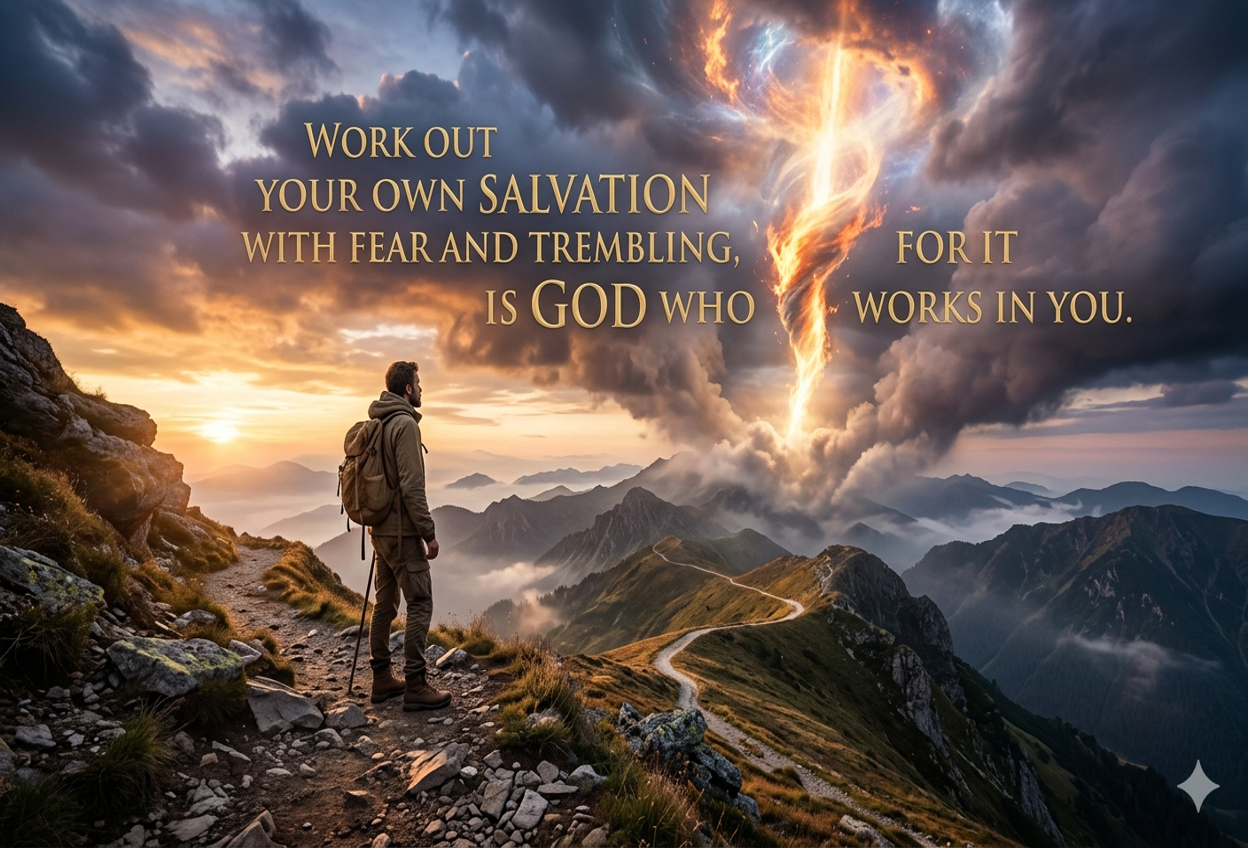

“Therefore, my beloved, as you have always obeyed, so now, not only as in my presence but much more in my absence, work out your own salvation with fear and trembling.”
PHILIPPIANS 2:12–13


Philippians 2:12 stands as one of the most structurally significant and theologically dense imperatives in the Pauline corpus. It represents the “Great Paradox” of the Christian life: the intersection of divine sovereignty and human responsibility. The verse commands:
“Therefore, my beloved, as you have always obeyed, so now, not only as in my presence but much more in my absence, work out your own salvation with fear and trembling.”
To grasp the exhaustive depth of this text, we must dissect it through the lens of its original Koine Greek, its immediate Christological context, and the broader tapestry of biblical soteriology and spiritual warfare.
I. The Contextual Fulcrum: The Hōste (Therefore)
The verse begins with the conjunction ὥστε (hōste), translated as “therefore.” In the architecture of Paul’s logic, a “therefore” is not merely a transition; it is a structural anchor. It connects the command of verse 12 to the majestic Carmen Christi (the Christ Hymn) of verses 5–11.
Deep Revelation:
Paul has just described the κένωσις (kenōsis)—the “emptying” of Christ. He descended from the μορφῇ Θεοῦ (morphē Theou—the “form” or essential nature of God) to the μορφὴν δούλου (morphē doulou—the “form” of a bondservant). The “work” we are called to do is an imitation of this descent.
Theological Depth:
In the original language, Christ became “obedient unto death” (ὑπήκοος μέχρι θανάτου). Our “work” is birthed from His finished work. Because Christ secured the ultimate victory through His humiliation and subsequent exaltation, our effort is not a pursuit of merit, but a response to the pattern of the Savior. We are not working for victory; we are working from the victory established in the preceding verses.
II. The Imperative of Action: Katergazesthe (Work Out)
The heart of the command lies in the Greek verb κατεργάζεσθε (katergazesthe). To understand this word is to understand the kinetic nature of the Christian life.
Linguistic Precision: This is a compound of κατά (kata—an intensive prefix meaning “down” or “thoroughly”) and ἐργάζομαι (ergazomai—“to work” or “to labor”). It signifies “to bring to completion,” “to finish a task,” or “to mine out a resource.”
Biblical Amplification:
The Mining Metaphor: In secular Greek, it described mining a field. The gold is already in the ground (salvation is the gift of the land), but the miner must “work it out” to manifest its value.
The Agricultural Metaphor: The land is legally yours, but you must “work it out” through tilling and sowing to produce a harvest.
Original Language Revelation:
The verb is in the present imperative middle, which implies a continuous, habitual action that the believer performs upon themselves. Paul is not saying work for (ὑπέρ) your salvation—which would be legalism—but work out (ἐκ) what God has already worked in. This is the doctrine of Sanctification. It is the process where the internal reality of Christ becomes the external reality of our conduct.
III. The Corporate Responsibility: Heautōn (Your Own)
A common Western misreading of “your own salvation” is a hyper-individualistic one. However, the Greek pronoun ἑαυτῶν (heautōn) is plural.
The Household of Faith:
Paul is addressing the ἐκκλησία (ekklesia—the “called-out assembly”). While personal salvation is the starting point, he is primarily concerned with the health, unity, and “salvation” (wholeness/safety) of the Philippian church body.Spiritual Warfare Connection:
In the context of the “Good Fight” (ἀγωνίζομαι), a soldier who does not “work out” his place in the phalanx endangers the entire unit. This echoes Hebrews 10:24: “Let us consider how to stir up one another.” We “work out” our salvation together to ensure the corporate body reflects the glory of the Exalted Lord, leaving no breach for the enemy’s infiltration.
IV. The Posture of the Soul: Phobos and Tromos
Paul defines the “atmosphere” of this work with two striking words: φόβου (phobos) and τρόμου (tromos).
Phobos (Fear):
This is the New Testament equivalent of the Hebrew יִרְאָה (yir’ah). It is not the slavish terror of a prisoner before a tyrant, but the “holy dread” of a child who understands the gravity of their Father’s holiness. It is the recognition of God’s Kavod (Weight/Glory).Tromos (Trembling):
This refers to a physiological reaction to the Presence of God. It is the “quaking” of a soul that realizes it is handling “Holy Things.”
Theological Depth:
Why “fear and trembling”? Not because we fear losing our salvation, but because we fear the mismanagement of so great a gift. We are “working out” the very life of God. To do so flippantly is a spiritual disaster. It is a “trembling” that stems from the realization of our own ἀσθένεια (astheneia—frailty/weakness) in the face of God’s δύναμις (dynamis—miraculous power).
V. The Divine Engine: The Energeō Synthesis
We cannot exhaustively study verse 12 without the “Bonus Revelation” of verse 13, which provides the reason (γάρ) for our effort: “For it is God who works in you, both to will and to work for His good pleasure.”
Energeō (Works):
The Greek word is ἐνεργῶν (energōn). God is the “Energy” within the believer. If verse 12 is the “work out” (κατεργάζεσθε), verse 13 is the “work in” (ἐνεργεῖν).The Will and the Work:
God provides the θέλειν (thelein—the very desire/volition) and the ἐνεργεῖν (energein—the operational power).
Theological Synthesis:
This is Synergism in sanctification. We work (v.12) because He is already working (v.13). Our effort is the “out-working” of His “in-working.” To work without His energy is legalism (dead works); to rely on His energy without working is antinomianism (passive presumption). Wisdom is found in the “Fear and Trembling” of cooperating with the Indwelling Spirit.
Exhaustive Conclusion: The Wisdom of the Work
To “work out your salvation” is to live in the tension of the Cross. It is to recognize that while the debt was paid in full by the Λόγος (Logos), the life must be lived in full by the believer. It is the daily liturgy of bringing our thoughts, words, and actions into alignment with the μορφῇ Θεοῦ (form of God) we have received.
Summary of Revelation:
Hōste: Our work is a response to Christ’s humiliation.
Katergazesthe: We must mine out the gold God has placed in our spirits.
Heautōn: We guard the corporate wholeness of the Body.
Phobos/Tromos: We maintain a posture of holy reverence for the Indwelling God.
Energeō: We acknowledge that even our desire to obey is a gift of His grace.
The Answer to the Architecture of Grace
The believer is called to a life of energetic cooperation with the Spirit, where human effort and divine power fuse to manifest the Kingdom of God on earth.
“Therefore, my beloved, as you have always obeyed, so now, not only as in my presence but much more in my absence, work out your own salvation with fear and trembling.”
PHILIPPIANS 2:12–13