The Pre-Existent Purity: An Ontological and Forensic Investigation into the Holiness of Christ Prior to His Baptismal Anointing

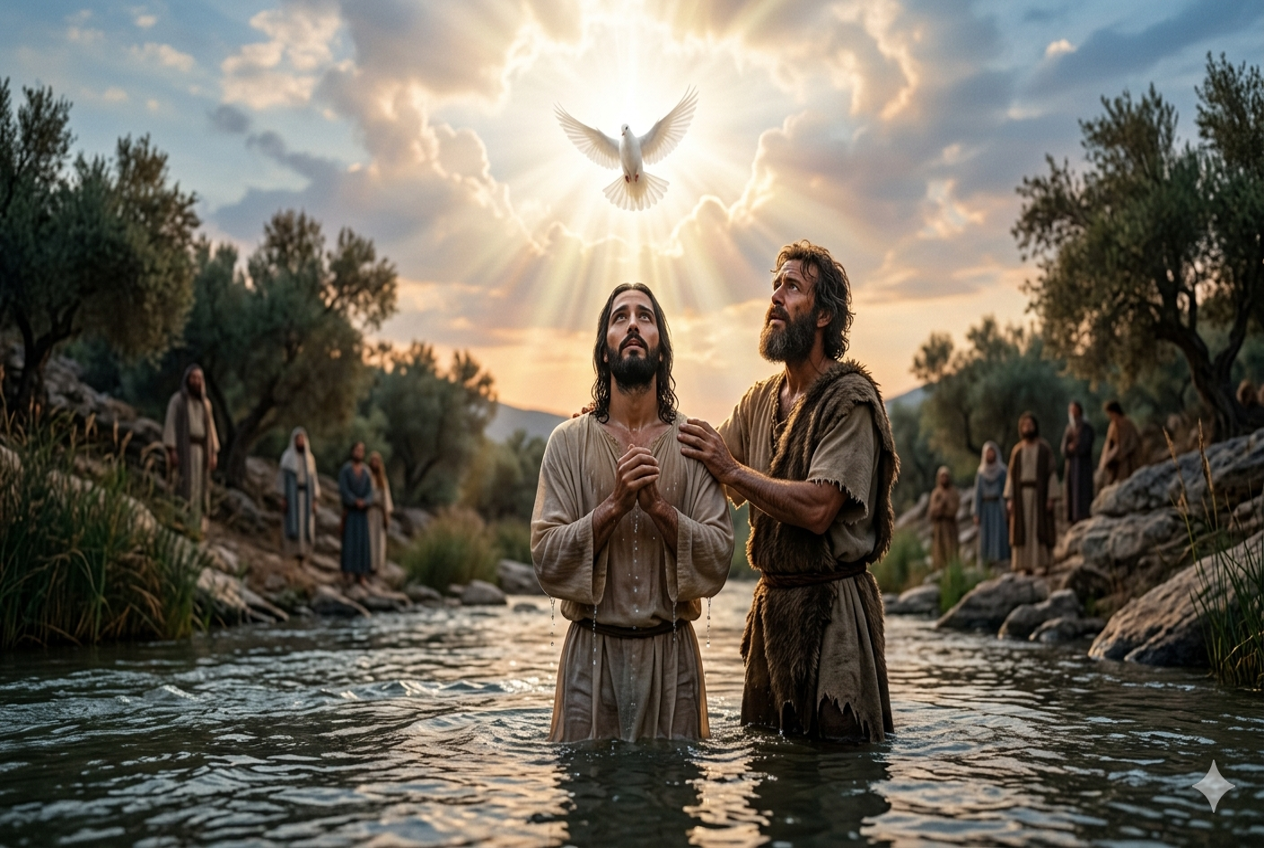
“And when Jesus was baptized, immediately he went up from the water, and behold, the heavens were opened to him, and he saw the Spirit of God descending like a dove and coming to rest on him; and behold, a voice from heaven said, ‘This is my beloved Son, with whom I am well pleased'”.
MATTHEW 3:16-17

The question of whether Christ possessed “holiness” prior to the descent of the Holy Spirit at the Jordan is not merely a biographical curiosity; it is a fundamental inquiry into the Hypostatic Union and the nature of the Logos. To suggest that Christ “became” holy at His baptism is to lapse into the ancient heresy of Adoptionism. Conversely, to understand His baptism correctly is to see it not as the acquisition of a missing holiness, but as the forensic inauguration of His Messianic office.
By synthesizing the Hebrew Masoretic Text, the Septuagint (LXX), the Dead Sea Scrolls (DSS), the Aramaic Targums, and the Syriac Peshitta, and by weaving in the sapiential and apocalyptic witness of Sirach, Wisdom of Solomon, Tobit, and 1 Enoch, we uncover an exhaustive biblical architecture proving that Christ was the “Holy One of God” from the moment of conception—and indeed, from before the foundations of the world.
I. The Ontological Root: The Logos and the Wisdom Tradition
To understand the holiness of the child in Nazareth, one must first look at the nature of the pre-incarnate Word.
1. The Chokmah (Wisdom) of the Septuagint and Sirach
The Wisdom of Solomon 7:22, 25-26 describes Wisdom as a “breath of the power of God, and a pure emanation of the glory of the Almighty... she is a reflection of eternal light, a spotless mirror of the working of God.”
Linguistic Edification: The Greek uses ἀπαύγασμα (apaugasma—effulgence/radiance), the same word used in Hebrews 1:3 to describe Christ.
Deep Revelation: If Christ is the Wisdom of God, His holiness is not an accidental attribute acquired in time, but an essential property of His being.
Sirach 24:9 reinforces this: “He created me from the beginning, before the world; and I shall never fail.” The Peshitta rendering of Sirach emphasizes that this Wisdom “dwelt in the high places,” a place of absolute Qodesh (Holiness). Christ did not “become” holy; He is the source from which holiness flows.
2. The Enochic “Son of Man”
In 1 Enoch 46:1-3, the “Son of Man” is seen with the “Head of Days,” and it is said that “this is the Son of Man who has righteousness, with whom righteousness dwells.”
Theological Depth: Apocalyptic literature like 1 Enoch, which heavily influenced the New Testament writers, presents the Messiah as a pre-existent figure characterized by intrinsic righteousness. He does not wait for a baptismal dove to be righteous; He is the “Holy One” who reveals the Head of Days.
II. The Purity of the Womb: To Gennōmenon Hagion
The forensic declaration of Christ’s holiness occurs at the moment of the Annunciation, long before the Jordan.
1. The Angelic Decree in Luke 1:35
The Angel Gabriel declares to Mary: τὸ γεννώμενον ἅγιον κληθήσεται υἱὸς Θεοῦ (to gennōmenon hagion klēthēsetai huios Theoū—“the Holy Thing being born shall be called the Son of God”).
Linguistic Revelation: The Greek uses the neuter hagion (Holy Thing), emphasizing that the very biological substance of the Incarnation is holy.
The Peshitta’s Qadisha (ܩܰܕ݁ܺܝܫܳܐ): The Syriac uses the emphatic form of holy. There is no period of “unholiness” or “neutrality.” From the embryonic state, Christ is Qadosh.
Dead Sea Scrolls Parallel (4Q246): The “Son of God” text from Qumran speaks of a figure who will be called “Son of the Most High.” In the Hebrew mind, to be the Son of God is to be of the same “nature” (mîn) as God—and God is uniquely Holy.
2. The Mosaic Prototype and Tobit’s Purity
In the Book of Tobit, the angel Raphael (Azarias) acts as a mediator of healing and holiness. However, Tobit 12:15 declares Raphael as “one of the seven holy angels who present the prayers of the saints/Holy Ones.”
Deep Revelation: If even the created messengers are “holy” by nature of their proximity to God, how much more is the Uncreated Son holy? Christ is the one whom the angels worship (Hebrews 1:6). He did not lack the Spirit; He was conceived by the Spirit (ek Pneumatos Hagiou).
III. The Silent Years: Wisdom in the Temple (Proverbs and Sirach)
The account of the twelve-year-old Jesus in the Temple (Luke 2:41-52) provides the bridge between His birth and baptism.
1. The Growth of the Logos
Luke 2:40 says, “the child grew and became strong in spirit, filled with wisdom (Σοφίᾳ); and the grace (χάρις) of God was upon Him.”
Linguistic Edification: The Greek plēroumenon sophia (being filled with wisdom) is a present participle. It describes a continuous state.
Theological Depth: This Wisdom is the Chokmah of Sirach 1:1, which “comes from the Lord and remains with Him forever.” Jesus was not a “normal boy” who suddenly became divine at thirty; He was the Incarnate Wisdom who, even at twelve, confounded the teachers of Israel. His holiness was the “fragrance” of His wisdom.
2. The Targumic “Memra”
The Aramaic Targums often replace “God” with the Memra (the Word). In Targum Onkelos, it is the (Memra-Word) that creates, judges, and sanctifies.
Exhaustive Insight: Jesus is the Memra made flesh. To ask if the Memra was holy before baptism is to ask if God is holy before He speaks. Baptism was not the source of His holiness, but the Voice of the Father identifying that holiness to the world.
IV. The Baptism: Function vs. Essence
If Christ was already holy, why did the Spirit descend?
1. The Anointing for Office (Meshiach)
In the Old Testament, priests and kings were anointed. Sirach 45:15 describes the anointing of Aaron with “holy oil.”
Linguistic Revelation: The Hebrew מָשַׁח (mashach—to anoint) is the root of Mashiach (Messiah).
Deep Revelation: Baptism was Christ’s Messianic Coronation. As Isaiah 61:1 declares, “The Spirit of the Lord God is upon me, because the Lord has anointed me.”
Forensic Reality: The Spirit did not descend to “make” Him holy; the Spirit descended to equip the Holy One for the specific task of the Kerygma (preaching) and the Stauros (cross).
2. The Testimony of the Baptist
John the Baptist, seeing Jesus approach, says in John 1:29: “Behold! The Lamb of God.”
Theological Depth: In the sacrificial system of Leviticus, a lamb must be tamim (spotless/perfect) before it is brought to the altar. Jesus did not become a “spotless lamb” at the Jordan; He was recognized as the spotless lamb because He was already holy.
Wisdom of Solomon 1:4-5 notes that “wisdom will not enter a deceitful soul, nor dwell in a body enslaved to sin.” Since Christ is the Sophia of God, His body was never enslaved to sin. He was the “Tabernacle” of God from the moment of Mary’s fiat.
V. Exhaustive Conclusion: The Eternal Sanctity
Christ was not “sanctified” by the waters of Jordan; rather, the Holy One sanctified the waters.
In Pre-existence: He is the Sophia of Sirach and the “Son of Man” of 1 Enoch—intrinsically holy.
In Conception: He is the Hagion of Luke 1:35—biologically and ontologically holy.
In Youth: He is the Memra of the Targums—experientially holy.
In Baptism: He is the Christos (Anointed One)—forensically identified as the Holy One of God.
To deny the prior holiness of Christ is to dismantle the Atonement. Only a priest who is “holy, harmless, and undefiled” (Hebrews 7:26) can offer a perfect sacrifice. Jesus was that High Priest from the cradle to the grave. His baptism was the “Secret Place” of the Father’s public approval of a holiness that had existed for all eternity
BONUS CONTENT: FURTHER ILLUMINATION
The Biological Tabernacle: A Forensic and Ontological Exposition of the Sinless DNA of Christ and the “Seed of the Woman”
The question of Christ’s holiness prior to His baptismal anointing leads inevitably to the mystery of His biological constitution. To understand how the Logos could inhabit human flesh without inheriting the Avon (iniquity) of the Adamic line, we must conduct a forensic investigation into the “Seed of the Woman” (Zera Ishah). This study explores the intersection of genetics and theology, demonstrating that Christ’s humanity was not a continuation of the fallen Adamic stream, but a New Creation—a second “Holy Ground” where the Divine and the Human met in absolute purity.
Through the lenses of the Hebrew Masoretic Text, the Septuagint (LXX), the Dead Sea Scrolls (DSS), the Aramaic Targums, and the Syriac Peshitta, as well as the sapiential and apocalyptic witnesses of Sirach, Wisdom of Solomon, and 1 Enoch, we shall uncover the mechanics of the “Sinless DNA” of the Messiah.
I. The Protoevangelium: The Zera Ishah (Genesis 3:15)
The blueprint for Christ’s biological exemption from the Adamic curse is found in the earliest prophecy of Scripture: “And I will put enmity between you and the woman, and between your seed and her seed; He shall bruise your head, and you shall bruise His heel.”
1. The Biological Anomaly: “Her Seed” (Zera’ah)
In Hebrew, the word for seed is זֶרַע (Zera). Biologically and linguistically, “seed” is almost exclusively attributed to the male in the biblical world.
Linguistic Edification: By using the phrase זַרְעָהּ (Zera’ah—“her seed”), the Holy Spirit bypasses the paternal line. In the Targum Pseudo-Jonathan, this verse is expanded to state that while the serpent’s seed has a remedy in the world to come, the “Seed of the Woman” will bring a crushing defeat to the serpent through the King Messiah.
Deep Revelation: The “Seed of the Woman” implies a biological “start-over.” Since the Yetzer Ha-Ra (evil inclination) and the legal debt of sin were transmitted through the federal headship of Adam (the male), a Messiah born strictly of the “Seed of the Woman” would be forensically decoupled from the Adamic inheritance of death.
2. The Wisdom of Solomon and the “Spotless Mirror”
Wisdom of Solomon 7:26 describes the Divine Wisdom as a “spotless mirror of the working of God.”
Theological Depth: If Christ is the Incarnate Wisdom, His biological “mirror” must be spotless. As Sirach 24 suggests, Wisdom “took root in an honored people.” The preparation of the “Seed of the Woman” was a multi-generational sanctification of a lineage, culminating in a womb that could host the Hagion (Holy Thing).
II. The Genetic Barrier: The Virgin Birth as Forensic Necessity
The Virgin Birth is not merely a sign of power; it is a forensic necessity to prevent the transfer of “Original Sin” (Peccatum Originale).
1. The Parthenos of Isaiah 7:14
The Septuagint (LXX) famously renders the Hebrew Almah as παρθένος (Parthenos—Virgin).
Linguistic Revelation: The Greek Parthenos carries a strict biological connotation of virginity. In the Syriac Peshitta, the word used is ܒܬ݂ܽܘܠܬ݁ܳܐ (Btulta), which reinforces this absolute purity.
Deep Revelation: By excluding the “Seed of Man,” God prevents the transmission of the nature of sin. As 1 Enoch 106 describes the birth of Noah as being “different” and “bright like the sun,” it hints at a higher standard for those who are born of a divine decree. How much more for the Son of God?
2. The Hagion of Luke 1:35
When Gabriel says, “The Holy Spirit will come upon you… therefore that Holy Thing (τὸ γεννώμενον ἅγιον) being born shall be called the Son of God,” he identifies the biological result of the union.
Ontological Purity: The Greek ἅγιον (Hagion) is a neuter noun, referring to the “biological product” of the conception. It is holy in its essence.
Dead Sea Scrolls (4Q246): This scroll mentions a figure who will be “great upon the earth” and “called the Son of God.” The Qumran community looked for a “Messiah of Righteousness.” This righteousness was not merely moral; it was genetic/ontological.
III. The Melchizedekian Lineage: “Without Father or Mother”
In the theological exposition of Hebrews 7, Christ is linked to Melchizedek, who is described as being “without father, without mother, without genealogy.”
1. Breaking the Adamic Genealogy
Deep Revelation: Every genealogy in Genesis 5 ends with the refrain “and he died.” This is the “Law of Sin and Death” encoded in human DNA.
Theological Depth: By having no human father, Christ’s “genealogy” does not lead back to the grave of Adam, but to the Throne of the Father. He is the Firstborn of a New Creation.
Sirach 44–50 lists the “praise of famous men,” yet it culminates in the High Priest. Christ is the “Greater High Priest” who does not offer blood for His own sins (Hebrews 7:27) because His own blood contains no “sin-marker.”
2. The “Son of Man” in 1 Enoch
In 1 Enoch 48:2-3, the Son of Man is named before the Sun and the signs were created.
Pre-Existent DNA: This suggests that the “Pattern” of Christ’s humanity was established in the Heavens before it was manifested in the Earth. He did not “evolve” from Adam; He “descended” as the Second Adam (1 Corinthians 15:47—“The second man is the Lord from heaven”).
IV. The Forensic Cleansing: Why Christ Was Holy from the Cradle
If Christ’s DNA was sinless, His entire life—from conception to baptism—was a continuous state of Active Holiness.
1. The Temple at Twelve (Luke 2)
When Jesus is in the Temple, His “Father’s business” (Luke 2:49) reveals His awareness of His unique origin.
Linguistic Edification: In the Greek, He says He must be en tois tou patros mou (in the things of my Father). He recognizes a paternal line that is Divine, not Josephite.
Wisdom of Solomon 1:4-5: “Wisdom will not enter a deceitful soul, nor dwell in a body enslaved to sin.” The very presence of the Logos in Jesus’ body is proof that His body was never enslaved to sin.
2. The Blood of the Covenant
Deep Revelation: The “Life is in the blood” (Leviticus 17:11). If Christ had inherited Adamic DNA, His blood would have carried the “death-sentence” of Adam.
Theological Apex: Because His blood was produced through the overshadowing of the Holy Spirit, His blood was Incorruptible. This is why Acts 2:27 (quoting Psalm 16:10) says, “You will not allow Your Holy One to see corruption.” Corruption is a biological process of death. Christ’s DNA was “pre-programmed” for Resurrection because it was never tainted by the “decay” of sin.
V. Exhaustive Conclusion: The New Genetic Order
The “Seed of the Woman” is the Genetic Declaration of War against the Kingdom of Darkness.
Forensically: Christ was born outside the jurisdiction of Adam’s debt.
Ontologically: Christ was born with the biological purity of the original Creation.
Linguistically: He is the Hagion (Holy Thing), the Memra (Word), and the Zera (Seed).
Christ was holy prior to His baptism because His very Molecular Structure was an extension of the Holy Spirit’s creative act. Baptism was not a “cleansing” of His DNA, but the Public Commissioning of the Sinless One to carry the sins of the world. He was the “Unblemished Lamb” from the womb, prepared by the Father to be the “Great Physician” whose own “Bloodline” would eventually be shared with all who believe through the New Birth.
Key Scripture Passages:
Matthew 3:16-17 (ESV): “And when Jesus was baptized, immediately he went up from the water, and behold, the heavens were opened to him, and he saw the Spirit of God descending like a dove and coming to rest on him; and behold, a voice from heaven said, ‘This is my beloved Son, with whom I am well pleased'”.
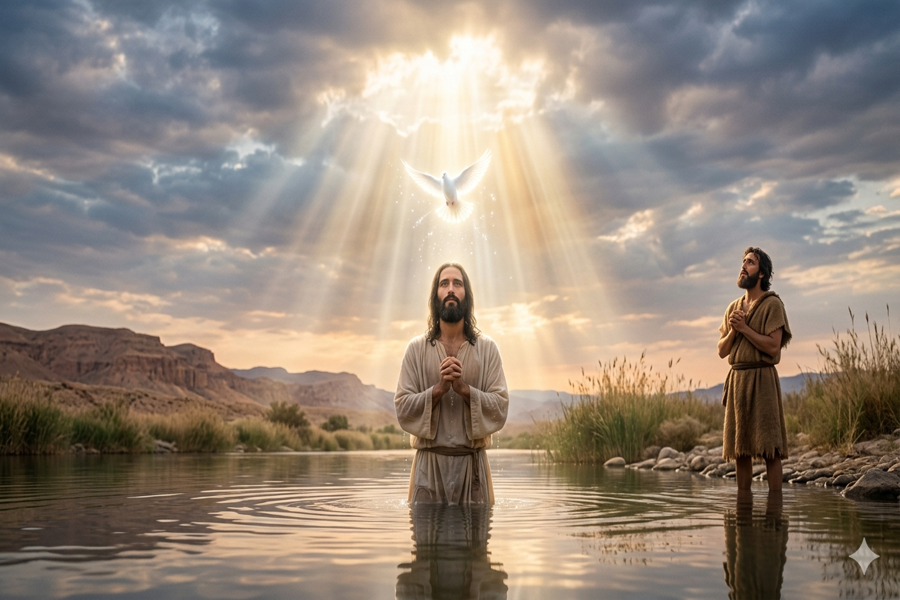
“And John bore witness: ‘I saw the Spirit descend from heaven like a dove, and it remained on him'”.
JOHN 1:32