


The Cosmic Architecture of Love: An Amplified Exegesis of the Greatest Commandments

And when the Pharisees heard that Jesus had silenced the Sadducees, they themselves gathered together. One of them, an expert in the law, tested Him with a question: “Teacher, which commandment is the greatest in the Law?” Jesus declared, “‘Love the Lord your God with all your heart and with all your soul and with all your mind.’ This is the first and greatest commandment. And the second is like it: ‘Love your neighbor as yourself.’ All the Law and the Prophets hang on these two commandments.”
MATTHEW 22: 30-40



The teaching of Jesus Christ reaches a profound theological summit—a “Mount Zion” of revelation—in His articulation of the “greatest commandments.” Found most explicitly in Matthew 22:34–40, this passage is far more than a moral summary; it is a comprehensive unveiling of the heart of the Father, the internal mechanics of the New Covenant, and the primary strategy for spiritual victory. When Jesus declares that all the Law and the Prophets hang upon two commandments—love for God and love for neighbor—He is not simplifying the law, but revealing its (telos) (purpose) and its divine, unbreakable unity.
I. The Linguistic Foundation: (Agapē) as Covenantal Warfare
The Greek text of Matthew 22:37–38 begins with a command that is both a legal decree and a spiritual invitation: “ἀγαπήσεις κύριον τὸν θεόν σου” (Agapēseis Kyrion ton Theon sou).
The verb ἀγαπάω (agapaō), used here in the future indicative, does not describe a fleeting emotion or a passive “feeling” of affection. In the context of the New Testament, Agapē is a volitional, sacrificial, and covenantal love. It is a love of the will.
Theological Depth: Unlike (philia) (friendship) or (eros) (desire), (agapē) is a “determined act of the soul” to seek the highest good of the other, regardless of the cost to oneself.
Warfare Connection: In spiritual warfare, the enemy’s primary weapon is self-interest. By commanding (agapē), Jesus is calling for the total assassination of the “ego.” To love God with (agapē) is to enter a state of total allegiance that renders the enemy’s temptations of pride and self-preservation powerless.
II. The Vertical Axis: The Shema and the Totality of Being
Jesus draws the first commandment from the “Shema” in Deuteronomy 6:5: “וְאָהַבְתָּ אֵת יְהוָה אֵלֹהֶיךָ” (Ve’ahavta et YHWH Eloheikha). To understand the “Greatness” of this command, we must go deep into the Hebrew anthropology Jesus is invoking:
With all your HEART (Lēvāv – לֵבָב):
In Hebrew thought, the lēvāv is not just the seat of emotion but the command center of the will, intellect, and intention. To love God with all your heart is to bring every thought and decision under His Lordship.Warfare Revelation: This is the “Breastplate of Righteousness.” When the heart is fully occupied by the love of God, there is no vacuum for the enemy to plant seeds of rebellion or “double-mindedness” (dipsychos).
With all your SOUL (Nephesh – נֶפֶשׁ):
(Nephesh) refers to the life-force, the breath, and the very essence of one’s being. It is your “appetite” for life.Warfare Revelation: To love with all your (nephesh) means your very survival is anchored in God. The enemy’s threat of death loses its “sting” (1 Cor 15:55) when your nephesh is already surrendered to the Father.
With all your MIND (Dianoia – διάνοια):
Matthew’s Greek inclusion of (dianoia) (intellectual faculty/understanding) emphasizes that our cognitive frameworks must be saturated with God.Warfare Revelation: This is the “Helmet of Salvation.” Spiritual warfare is fought in the realm of “arguments and every lofty opinion raised against the knowledge of God” (2 Cor 10:5). Love for God with the (dianoia) means pulling down every mental stronghold that contradicts His Word.
III. The Horizontal Axis: The Neighbor and the Imago Dei
The second commandment, from Leviticus 19:18, is “You shall love your neighbor as yourself.” The Hebrew word for neighbor is רֵעַ (rēa‘), meaning a companion, a friend, or “another.”
Jesus uses the Greek πλησίον (plēsion), which literally means “the one who is near.” This effectively collapses all ethnic and social barriers. The phrase “as yourself” (hōs seauton) is not a command for “self-love” in the modern psychological sense, but an acknowledgement of the inherent instinct for self-preservation.
Theological Depth: Jesus is commanding us to take the intense energy we naturally use to protect, feed, and defend ourselves and redirect it toward the “other.”
Warfare Connection: The enemy’s kingdom is built on division (diabolos literally means “the divider”). Loving the neighbor is a “counter-insurgency” against the kingdom of darkness. Every act of sacrificial love toward a neighbor is a direct blow to the “accuser” who thrives on strife, bitterness, and unforgiveness.
IV. The Structural Integrity: The Hinge of the Universe
The climactic statement—“On these two commandments hang all the Law and the Prophets”—uses the Greek verb κρέμαται (krematai).
Deep Revelation: (Krematai) means “to hang,” as a door hangs on hinges or a body hangs on a cross. If you remove the hinges, the entire door of the Law falls. Without love, the 613 (mitzvot) (commandments) of the Torah become “hollow” (kenos) and legalistic.
Warfare Connection: The enemy loves “religious spirits.” He is perfectly happy for a believer to be “biblically accurate” but “love-deficient.” Jesus reveals that Love is the spiritual gravity that holds the Word of God together. Without it, your “theology” has no weight in the spirit realm (1 Cor 13:1).
V. The Fulfillment: The Cross as the Ultimate Equation
Theology finds its physical manifestation in the Person of Jesus Christ.
Vertical Fulfillment: On the Cross, Jesus showed the world what it looks like to love the Father with all His (nephesh) (soul/life). It was the ultimate act of Agapē—obedience unto death (Phil 2:8).
Horizontal Fulfillment: Simultaneously, He was loving His “neighbor” (humanity) by taking our (ponos) (toil/pain) and sin upon Himself.
The Cross is the geometric intersection of the Greatest Commandments. It is the vertical bar (Love for God) and the horizontal bar (Love for Neighbor).
VI. Practical Application in Spiritual Warfare
To live out these commandments is to be “armored” for the final victory:
Love for God destroys the “Lust of the Flesh”: When God is your “all in all,” the counterfeit pleasures of the enemy lose their luster.
Love for Neighbor destroys the “Pride of Life”: When you serve others “as yourself,” you crush the “I” that the enemy uses as a foothold.
The Unity of the Two: You cannot have one without the other. 1 John 4:20 calls the man who claims to love God but hates his brother a “liar” (ψεύστης, pseustēs). In warfare, a lie is a “leak” in your armor. Total integrity (Love for God + Love for Neighbor) is what makes your spiritual armor “impenetrable.”
Conclusion: The Eternal Reign of Love
Eschatologically, these commandments are the only “laws” that will survive into the New Heavens and New Earth. In the eternal state (Rev 21-22), the “Law of Love” is no longer a command to be obeyed, but the very atmosphere of existence. To practice these commandments now is to begin living in the reality of the Final Victory today.
By loving God with the totality of our being and our neighbors as ourselves, we are not just “following rules”—we are exercising our Sholtana (dominion), enforcing the Kingdom of Light, and proving that the “gates of hell” cannot prevail against a heart that has become a temple of Agapē.
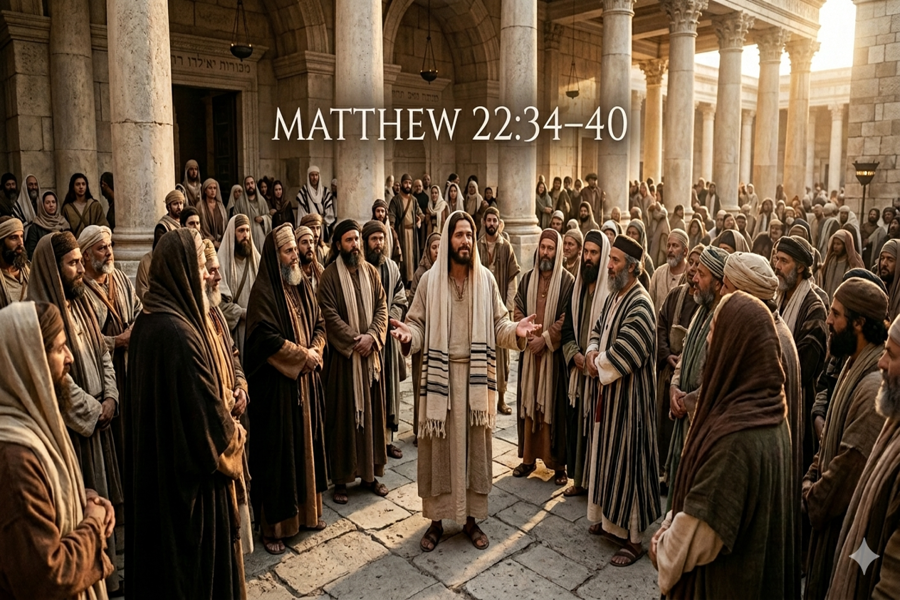
And when the Pharisees heard that Jesus had silenced the Sadducees, they themselves gathered together. One of them, an expert in the law, tested Him with a question: “Teacher, which commandment is the greatest in the Law?” Jesus declared, “‘Love the Lord your God with all your heart and with all your soul and with all your mind.’ This is the first and greatest commandment. And the second is like it: ‘Love your neighbor as yourself.’ All the Law and the Prophets hang on these two commandments.”
MATTHEW 22:30-40